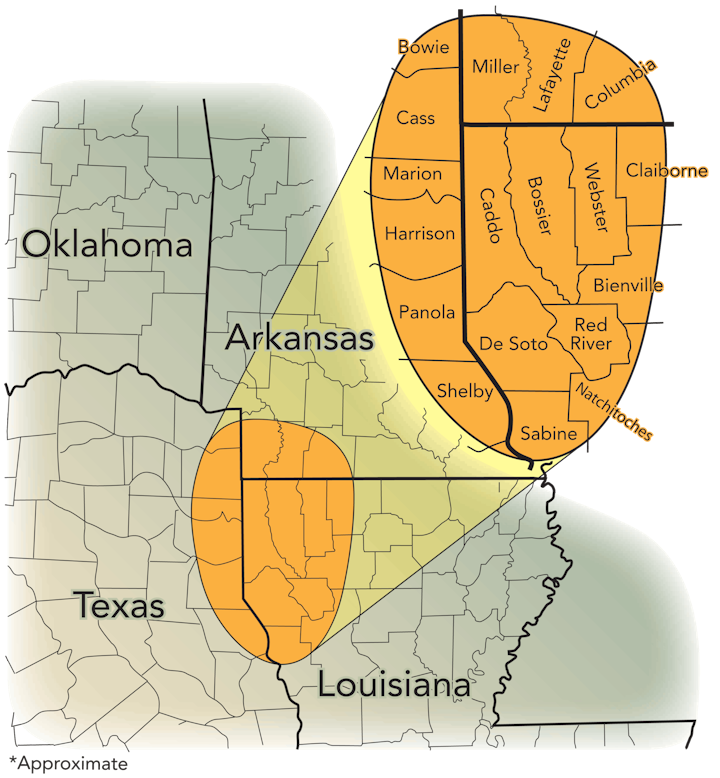
DeSoto Parish, LA
The Haynesville Shale is an informal, popular name for a Jurassic-Period rock formation that underlies large parts of southwestern Arkansas, northwest Louisiana, and East Texas. It lies at depths of 10,500–13,000 feet (3,200–4,000 m) below the land’s surface. It is part of a large rock formation which is known by geologists as the Haynesville Formation. The Haynesville Shale underlies an area of about 9,000 square miles (23,000 km2) and averages about 200–300 feet (61–91 m) thick. The Haynesville Shale is overlain by sandstone of the Cotton Valley Group and underlain by limestone of the Smackover Formation. It contains vast quantities of recoverable natural gas. This natural gas is known as "shale gas" because the wells produce from low-permeability mudstones that are also the source for the natural gas. It was known to contain large quantities of natural gas prior to 2008. However, prior to that time, it was uneconomic to extract the natural gas. As a result of rising gas prices and improved technology in hydraulic fracturing and directional drilling, it became possible to extract the gas from the Haynesville Shale in an economic manner.
In July 2025, Hayneville gas production reached an all-time high at 15 Bcf/d In its most recent forecast, the U.S. Energy Information Administration estimates Haynesville region natural gas production will average 15.6 Bcf/d in 2026. The gas shipped on the new pipelines from the Haynesville region to the Gulf Coast will supply LNG terminals located in the Port Arthur, Texas, area, just a few miles west of the Louisiana border. The Golden Pass LNG terminal now under construction in Port Arthur is expected to begin commercial service near the start of 2026, and by the end of the year gas supplies totaling about 2.55 Bcf/d from both the Permian and Haynesville basins. The property has 16 horizontal wells and are averaging 4,729,626 Bcfg/month.
- Royalty Interest ownership is one of the most conservative investments in oil and gas because you own the minerals underneath the ground for life and you are paid a % of the revenue stream from production on the acreage. Your monthly passive income stream has tax benefits.
- Investing in drilling projects are speculative and very risky for the investor because if the well is not commercially viable or a marginal producer could cause the investor to lose his/her entire investment.
- A horizontal well can be fracked 3 times throughout its life which extends the life of the well and the reserves to be produced. Once the operators make the decision to re-enter the wells and frack for the 2nd time and 3rd time, this is no cost to a royalty interest owner and could dramatically increase the monthly and annual passive income as well as the production lives of the wells.
- As oil, natural gas, and LNG continues to increase in price, the passive income from the producing wells increases.
- Diversification in royalty interest gives your portfolio more stability and passive income and creates another strong investment in your portfolio without putting you in a risky situation for the monthly and yearly passive income for decades.
-